
Resident’s participation and mutual aid on social housing
The issue of resident’s participation and mutual aid is of great importance regarding the self-construction of homes, and other forms of social housing, such as housing cooperatives. Read the text on resident participation regarding housing and planning, before reading the texts on housing cooperatives
2025 Documents by Jan Bredenoord:
Download: Resident’s participation and mutual aid on social housing. Bredenoord. 2025
Download: New Housing Cooperatives with Mutual aid in Latin American Countries. JBR 2025
Housing cooperatives – general information
Housing cooperatives are or can become vital builders and maintainers of (small) housing complexes. The households, while cooperating in small groups, can be or become important players in house building, home renovation and the improvement of their residential environment. House building within a cooperative context has a number of advantages over individual house building. Participants in cooperatives regularly motivate one another, and mutual training can be delivered easily to a group. Cooperatives can organise their interests better, in order to negotiate as a strong community with local governments and utilities, and, in the end, the housing quality will be better than that of individual (self-built) houses. The following are some of the aid organizations that support the establishment and the management of housing cooperatives:
FUCVAM: the Uruguayan Federation of Housing Cooperatives for Mutual Help. See: www.fucvam.org.uy
The Swedish Cooperative Centre ‘We Effect’ promotes housing cooperatives in 25 countries in Africa, Asia, Europe and Latin America (See below).
The National Cooperative Housing Federation of India (NCHF) is a nation-wide organization that takes the lead in promoting, coordinating and facilitating the development of housing co-operatives, along with providing guidance to housing co-operatives and their federations. See: www.nchfindia.net
We Effect. The vision and working methods of We Effect, the Swedish Cooperative Centre, are of importance concerning housing and habitat. This international aid-organization works in various countries in Latin America, Africa, and Asia. The Research Project (2016) on housing cooperatives was executed by Jan Bredenoord in close cooperation with We Effect. The title is: ‘Evaluación del Programa Regional Vivienda y Hábitat”, We Effect, América Central. Many more publications are to be found about We Effect’s work.
Examples of housing cooperatives
1. in Guatemala
- Housing cooperative Fe y Esperanza. San Pedro Sacatepéquez, Guatemala City
This residential area of Fe y Esperanza is located in the municipality of San Pedro, 22.5 km from Guatemala City. The cooperative was founded in 2004 and obtained the land in the same year with help of the NGOs IDESAC, ‘Juan Pablo’, and We Effect. The community house was built in 2008. First houses were built in 2010. In 2016 nine houses were completed. The group’s members designed the houses and the subdivision plan, together with architect Luis Estrada of IDESAC. The living area of the house is 58 m2 and the plot area is 105 m2. The loan for the construction of homes was obtained from Habitat for Humanity. Number of dwellings was 21 in 2016.
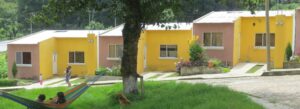
- Housing Cooperative EL ESFURZO SOLIDARIO. San Miguel Petapa, Guatemala City.
The members of this housing cooperative came from several colonies. In 2016, the group consists of 14 families, and there are 14 houses built. Still, six houses can be added. The preparation of the site lasted a long time due to the difficult circumstances of the area with huge differences in elevation. The partners have begun economic activities to earn family incomes. Technical training of the families began in 2005 with a group of people that got contact with the NGOs IDESAC and We Effect. The group already had saved money with the objective to buy land for housing. Starting from 2006, the cooperative obtained the status of a legal person. In December 2006, it could proceed with the purchase of the land. The surface of the land is approximately 0.7 hectare. The families had already worked two years on the preparation of the land for construction, which had been finished in 2009. The search for housing finance was difficult. At the end, an agreement between Habitat for Humanity and We Effect resulted in a loan for housing, at an interest rate of 10 percent on the sum, at a yearly base, with a period of 10 years. In 2010, the families have started to build 14 houses, which lasted 1 year and 4 months. The homes have 54 m2 living space, including two bedrooms on plots of 6 by 14 m, with a total surface of 84 m2. Later, they expanded the houses with an extra bedroom with funding from We Effect, with a soft loan of 2 percent interest and a 10 years period. In 2016 the community had 55 inhabitants. The central area is a square with a slim line water tower in the center. Sewage water is cleaned organically, and the rest flows into a common garden with banana trees. Raining water is collected for the cooperative’s own use.

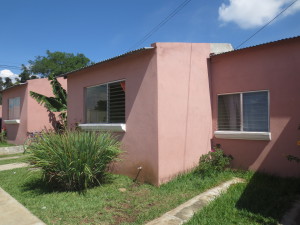
2. in Mexico
- Housing cooperative ‘Guendaliza’a’. Cuchilla Pantitlán, Mexico City.
The objective of Guendaliza’a was the construction of a dignified living space for 48 families in the east of the Mexican capital. In their effort to make the Right to the City effective, these families have encountered the cooperative model and now have the difficult task of opening the way to a new generation of public policies that recognize new forms of social property. Construction of the houses began in 2015. At the same time, the cooperative has been promoting a neighborhood improvement program that seeks to improve coexistence and cultural services for the benefit of all the inhabitants of the area.

- Housing cooperative Unión Palo Alto, Mexico City.
The Palo Alto Cooperative was established 50 years ago as a suburban development. In the course time it managed to constitute 210 homes and a suitable habitat, in one of the most dynamic cities in Latin America, Mexico City. During the decades, its surroundings became highly urbanized. Today, the cooperative endures as a place with an adequate habitat, thanks to the mutual bond of the members, the housing quality, the facilities and services, and the resistance of cooperative families. Since 2010, the Palo Alto Cooperative, together with the Popular Urban Movement started with the search for other cooperatives in the same area in the city. It is currently made up of six legally constituted housing cooperatives, Palo Alto Cooperative, Xochiquetzelli Cooperative, Equity and Development Cooperative, Matzhi Cooperative, Joaquín Mendizábal Cooperative, and the one that is in the process of being constituted, Yolizcan Cooperative.

See: https://sociologiaurbana.azc.uam.mx/wp-content/uploads/2021/04/Memoria_identidad_y_participacion_Quiroz_Mendoza_M_A_2019.pdf
3. in Bolivia
- CACVAM Housing cooperatives
The organization CACVAM (Centro Articulador de Cooperativas de Vivienda por Ayuda Mutua) functions as an organization covering several housing cooperatives in the Department of Cochabamba, Bolivia. Housing cooperatives being member of CACVAM:
- Cooperative ‘Señor de Piñami’ (Covisep), in El Paso, Quillacollo, with 30 houses built.
- Cooperative ‘Virgen del Rosario’ (Covivir), in the municipality of Sipe Sipe, with 12 houses built; now in phase of obtaining government finance for more houses.
- Cooperative ‘Convento Molle Molle’ (Covicom) is in its consolidation phase of obtaining government finance, on the same terrain as COVIVIR.
- Cooperative ‘Sayariy’ (Cosvams) in Quillacollo, is in search to land for housing.
- The pre-cooperative “Don Bosco” (Covibos) started a procedure to become a legal cooperative.
- The pre-cooperative ‘Paradise’ (Covipa) started a procedure to become a legal cooperative.

Houses in the cooperative ‘Señor de Piñami’, municipality of Quillacollo, Department of Cochabamba.
4. in El Salvador:
- Cooperative ACOV Independencia
This housing cooperative is located in one of approximately 100 ‘mesons‘ that are located in the historic center of San Salvador. A meson is a residential area in the historic city center, where very miserable housing situations can be found. This concerns sometimes old buildings in disrepair or abandoned land, now giving home to thousands of poor people who try to survive by working in the informal sector in the city center. These mesons can be found in closed areas, that often are invisible from the road. The 21 families of the housing cooperative ACOV Independence lived in this meson in temporary and miserable shelters that were auto-constructed (2016) The number of settlers was then 120. In 2008, a process of training the group was started, with the support of FUNDASAL and the cooperative has retrieved the status of legal entity. The land was purchased by FUNDASAL and disposed to the housing cooperative. This was made possible by a fund for ‘land for housing’ by FUNDASAL. The residents of the cooperative have available a construction plan for the building of 24 apartments In January 2017 (see below the design prepared by the NGO Fundasal). The proyect is part of the reconstruction program of the historic city center, that is approved by the government. There will be built 420 houses in several cooperatives in the historic center. This has been made possible thanks to the efforts of FESCOVAM, making possible that the loan granted by the Italian Cooperation to the Government of El Salvador, is focused completely on cooperative housing for the historic center.
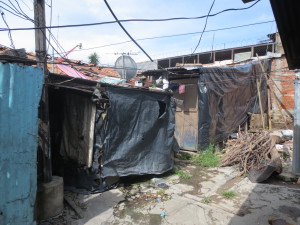
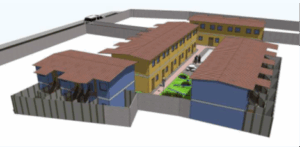
Left: Situation in 2016 Right: Urban Design by FUNDASAL
Download: Document FUNDASAL and FESCOVAM ANEXO 2 Carpeta Técnica ACOVINDEPENDENCIA
- Cooperative ACOVICHSS. San Esteban, Historic Center of San Salvador. El Salvador.
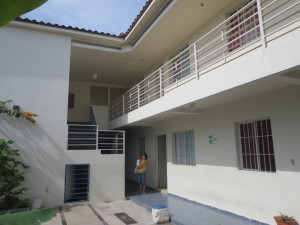
The members of the housing cooperative ACOVICHSS in the barrio of San Esteban, have constructed their homes in two locations in the city center of San Salvador; one of 12 houses and another nearby of nine houses. In August 2016, the first project has 12 houses. Four heads of families are men and eight are women. Most heads of households work as vendors in the informal market. The cooperative began in 2001 and is a legal entity from 2004 on. The first project was carried out in 2008/2009 and the second one in 2009/2010. During the construction period, each partner of the cooperative had to contribute with their own hands (or by the hands of a family member) 24 hours per week. It was said that it lowered the building costs with 40 percent. The Ngo FUNDASAL offered training and technical assistance for the project formulation, the management, the gaining of funds and the solidarity necessary for the execution of the mutual project. During the construction phase, FUNDASAL provided a team of four technicians. The municipality of San Salvador stimulated the project, as consequence of its policy of “the rescue of the residential function of the historic center of San Salvador”. The housing project was realized with funding from the Spanish aid agency (AECID), We Effect (Sweden), MISEREOR (Germany) and Cordaid (Netherlands). The housing complex is built in two floors and the dwellings are nice apartments (36 – 47 m2). After the completion of the housing project, the municipality of San Salvador realized a square nearby, and modified the adjacent street, in favor of the residents and the surrounding area.
5. in Honduras
- Cooperative COVICHOLUMAR. Choluteca, Honduras.
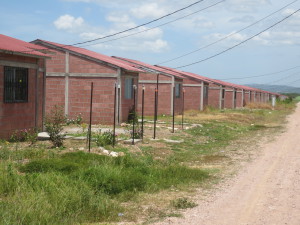
It concerns a completely new peri-urban land development, which in the end will contain 558 houses. The community is located at a distance of 8 km from Choluteca. In the surroundings, one can find mainly rural functions, but at the other side of the regional road a large solar power plant is located. The site is connected to a regional road that gives commercial opportunities. The new residential site has all the necessary services such as drinking water, connection to the electrical network, and a sewerage system with a waste water treatment facility. The streets within the urbanized area are only paved with selected materials. The cooperative’s members have formed a first group in 2010, and in 2012 they obtained the status of a legal entity. The members of the cooperative have bought the project’s terrain with the money they obtained through jointly executed commercial activities. Funding for housing was made possible by a subsidy (US$3000 per house) and a loan – the two were granted and facilitated by the national government. At the end of 2015, the first phase of the housing project was realized, with 173 dwellings. The cooperative has a loan of 10 percent on a yearly basis, with a term of 20 years. The residents have several internal working committees, such as the committees of support, surveillance, education, environment, and water management. Initially, they have built mutually a community facility. Within the first urbanistic plan for the 173 homes, all are single family houses. This is expected that within the subdivision plan for 558 plots for housing, the second and third stages will contain also single family houses. The total project is equipped with roads, drainage, and green spaces. Additionally, an area located beside the main road, is reserved for the commercial functions and for production and education. This gives good opportunities for employment creation in the vicinity of the residential area. Later, other facilities can be added, such as a playground for children and parks. The dimension of the plots is 12 by 18.5 m; the surface is 222 m2. Initially, only single-family houses were built with a surface of 42 m2. The majority of the heads of households have their work in Choluteca or in its vicinity. This cooperative is the biggest housing cooperative in Central America; in the end, they expect to have between 2500 and 3000 residents in the 558 houses, that are planned in the neighborhood.
6. in Nicaragua
- Cooperative JUNTANDO MANOS. Reparto Mariana Sansón, León, Nicaragua.
The housing cooperative through mutual aid ‘Juntando Manos’ is located in the urban expansion project León South East, in the municipality of León. The cooperative was founded in 2004 and in 2007 the members began the building of the houses. This housing cooperation was the first in Nicaragua, together with the cooperative ‘Lomas de Pochocuape’ in Managua. The two were built according to the principles of FUCVAM and We Effect. The land of Juntando Manos was purchased from the municipality, within the framework of the León South East expansion plan. The neighborhood is called ‘Mariana Sansón’. Most of the heads of households who live here have jobs in the informal and formal economy. Most of them work in the city of León, a few kilometers away. During the initial processes, they have been successful in attracting financial support from financial aid organizations. In the vicinity of the cooperative Juntando Manos, nine other locations for housing cooperatives are prepared for mutual housing. One is realized (‘Los Volcanes’) and 8 other housing cooperatives – all located in the nearby neighborhood ‘Utrecht’ are preparing the house construction, but in seven cases the housing finance is not yet arranged (2016). A communal facility is built in 2015 to serve for all the cooperatives that are located and planned in this area. When the houses were built, the families had already purchased the land with a loan from the municipality of León. This loan has been fully paid off. Residents have obtained much support from We Effect, with the construction of the buildings and also during the consolidation process. In 2016, the residents of Juntando Manos only have a credit from We Effect for the houses, at annual interest rate of 2 percent, duration 20 years. The 36 houses of Juntando Manos, were built around a courtyard where a communal space is. The houses have a floor space of 42 m2. The surface of the plots is 160 m2. The surroundings of the houses are green. The cooperative houses are painted in different exterior colors and this gives extra quality to the housing complex. It is not a boring residential area, as is sometimes the case in other new neighborhoods. In the near future, the residents of this cooperative want to continue the consolidation process of the area. Among other things, they want to create a facility for the guidance of small children. Special is the aspect of the design of the subdivision around the internal patio; this gives a variation of colors while the architecture and urban design are attractive. It is special that this cooperative was the first one in Nicaragua. It obtained very much attention, nationally as well as internationally.
